Introduction
Never quiescent, the Craft family continued to fight for the lives and livelihoods of Black Southerners. The Crafts aimed to develop a farming school that encouraged cooperation among newly freedpeople and also disrupted the white-controlled labor systems sweeping the former slave states. The Crafts’ efforts, however, met with white supremacist violent backlash.
Dreams of Cooperation
Amidst the family’s transition from England to homesteading back in the United States, Ellen gave birth to a son they named Alfred George, who may have been born before the family left or once they returned to the United States – or, there is a small chance Ellen gave birth at sea. After a brief stay with some friends in Boston, the family traveled south in April of 1870 to Savannah (Sterling 1988, 49, 51; Anonymous 1878h). The Civil War had brought the end of slavery, but not the end of the struggle for freedom, life, and rights for Black Americans.
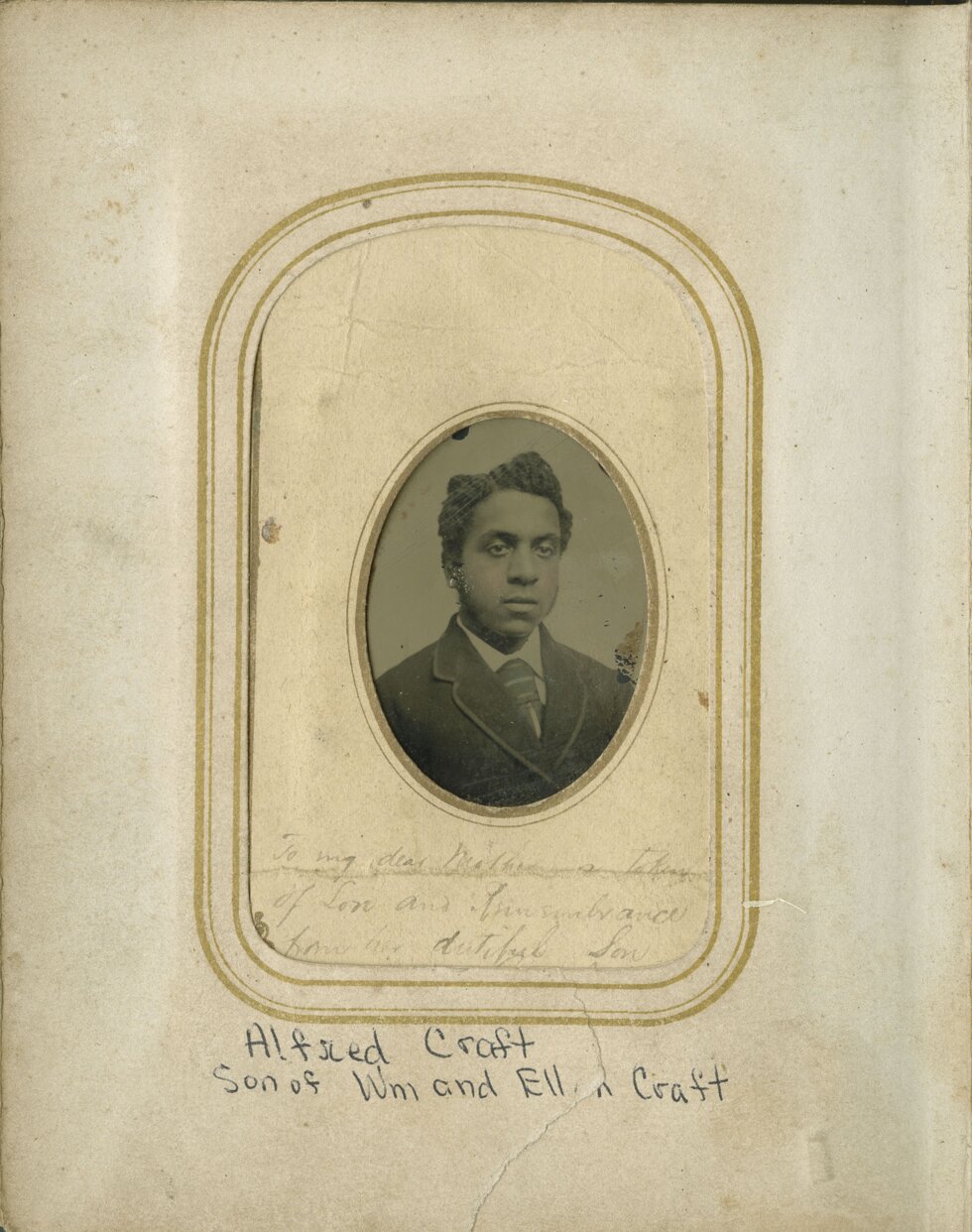
Anonymous, “Alfred Craft” (Photograph, [c.1860-1938]), AMN 1102, Avery Research Center, Charleston, United States. Courtesy of Avery Research Center for African American History and Culture, College of Charleston Libraries. All rights reserved. This is one of 7 images published by this project, all of which exhibit the same material characteristics due to coming from a single album held by the Avery Research Center. This photo of Alfred Craft, one of William Ivens’ brothers, is accompanied by a note that reads, “To my dear Mother, a Token of Love and Remembrance from her dutiful Son.” Alfred and his older brother, William Ivens, bore a striking resemblance.
The confusion and speculation over the birth of Alfred Craft stems from the fact that William and Ellen, uncharacteristically, did not register the birth of their son. As a result, Alfred’s birth date is a question the descendants still actively research. Martin Copeland, great-grandson of William Ivens, mentions that he has two sources that give 1869 as Alfred’s birth year. Chris Clark, another great-grandson, says the birth might have been in England, at sea, or the U.S., but, the family “clique knows it was in the US,” they just “don’t yet have the documents” (Copeland 2023b; Clark 2023b). Historian Dorothy Sterling asserts that Alfred was born in England before the Crafts returned to the United States (1988, 49). It is the absence of these seemingly mundane records – such as a missing birth registry – that make the Craft history and genealogy a living and changing story.
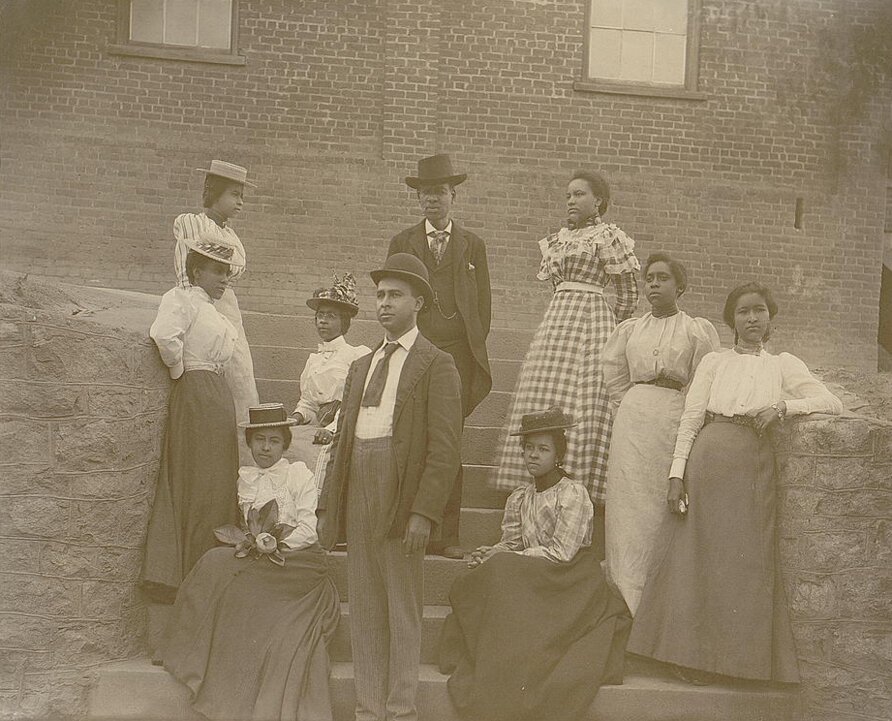
Thomas E. Askew, “African American Men and Women Posed for Portrait on Steps at Atlanta University, Georgia” (Photograph, Atlanta, [c.1899-1900]), Du Bois, W. E. B. (William Edward Burghardt), 1868-1963. Du Bois albums of photographs of African Americans in Georgia exhibited at the Paris Exposition Universelle in 1900. Library of Congress Prints and Photographs Division Washington, D.C. 20540 USA dcu. LOT 11930, no. 348, Library of Congress, Washington, United States. No known restrictions on publication. Alfred Craft, whose place of birth remains a mystery, attended what is now the oldest HBCU in the Southern US during the years 1885 to 1891. This image, captured around 1899 or 1900, represents well the milieu that Alfred would have been familiar with during his time at the school.
In Georgia, Alfred attended the oldest HBCU in the Southern United States, Atlanta University, now Clark Atlanta University (Atlanta University 1886-1888; 1890-1891). Meanwhile, his family helped fund and manage Hickory Hill, a plantation leased by William Thompson “on the Charleston road” in South Carolina, just across the border from Savannah (Anonymous 1878b). The Crafts’ dream was a farming school that encouraged cooperation among newly freed people and disrupted the coercive, and white-controlled, contract labor system. During the farm’s first year, “a very good crop was raised,” William later reported, and Ellen “taught five or six children and seven or eight adults. There were three families on the place” (Anonymous 1878d; 1878f).
The Burning of Hickory Hill and Founding of Woodville
After only one year of farming, however, Hickory Hill – a farm co-operated and leased by two Black men in Reconstruction-era Georgia – erupted into flames one night. William Craft later reported that “the kuklux [sic] burned the buildings at Hickory Hill.” Ellen remembered the terrifying night. She hurried the children out of the burning building, wearing only their night clothes. She managed to save some of their money from the conflagration (Anonymous 1878b; Anonymous 1878c).
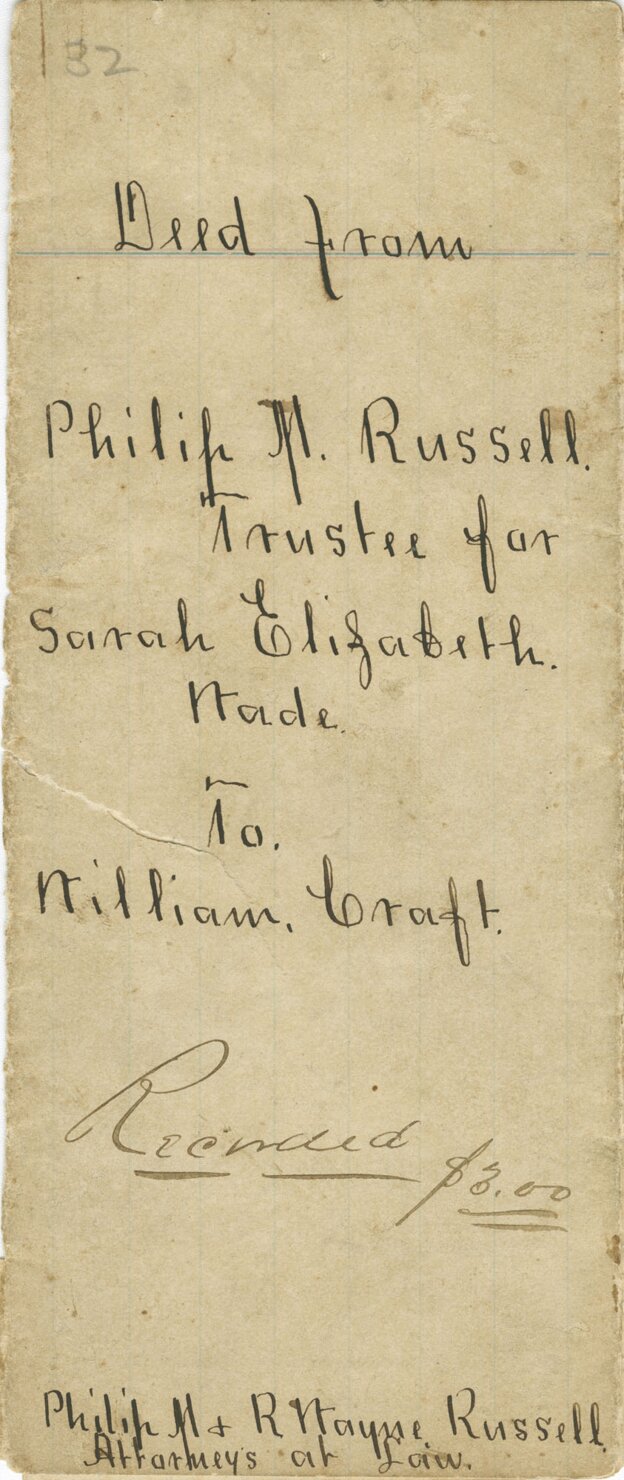
Philip M. Russell, “‘Woodville Plantation Deed, 1873’” (Manuscript, [1873]), AMN 1102, Avery Research Center, Charleston, United States. Courtesy of Avery Research Center for African American History and Culture, College of Charleston Libraries. All rights reserved. The deed for the Woodville Co-Operative Farm School is extant today in the collection held by the Avery Research Center. The Crafts sought this lease after the Ku Klux Klan, in an act of terror and intimidation, burned the family's first educational project. The Crafts were not deterred.
With hardened resolve, William and Ellen next established Woodville Co-Operative Farm School in their home state of Georgia (Sterling 1988, 52). There, the Crafts also founded a free school, which was at the time the only school in Bryan County, a majority-Black seaboard county known for its rice and cotton plantations (Blackett 1983, 61; 1986, 125).
By 1875, although it had put the family into debt, Woodville seemed to be blossoming. The Crafts built a large schoolhouse attended by upwards of 75 students. At least sixteen families lived on the property, farming cotton, rice, and corn (Craft 1875). Ellen and Brougham taught in the school, seldom receiving compensation. Brougham had earned certificates for teaching from school committees in Georgia and Florida. Though some of the scholars had promised to pay, recalled Brougham, he “never got anything from them, except four red birds” (Anonymous 1878e).
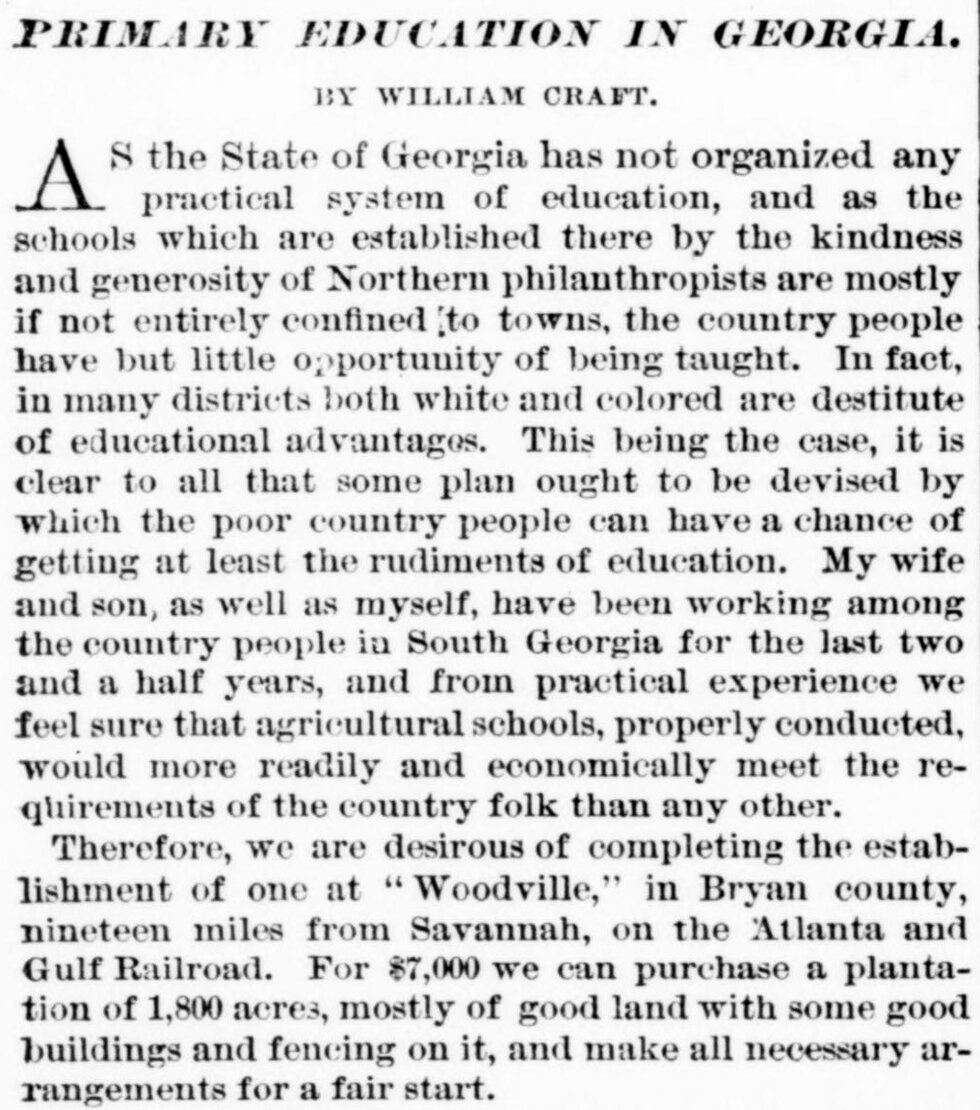
William Craft, “’Primary Education in Georgia’” The Christian Union 8, no. 5 (30 July 1873): 92, Internet Archive. No known restrictions on publication. William Craft penned this article to not only make known his hopes for the Woodville school, but also likely to drum up support, financial and otherwise, for the endeavour.
The Craft family also became involved in Reconstruction politics, joining the Republican Party in Georgia. William Craft, in 1873, applied for the office of Minister to Liberia, “with good prospects” the Augusta Chronicle reported (Anonymous 1873). The next year, he ran for state Senate in Georgia as a Republican (Anonymous 1874c). Both campaigns proved unsuccessful. However, in 1876, William represented Bryan County at the Georgia Republican State Convention. There, he was elected as an alternate delegate to the Republican National Convention (Blackett 1986, 129; Anonymous 1876b). Politics was a family affair. In Savannah, William Ivens’ older brother, Charles, was president of the Union Coterie club (Craft 1876).