Introduction
William Ivens Craft was young and exhibited resiliency; his story was just beginning. A Black, British-born, educated, twenty-five-year-old man, he turned his gaze to freer shores – just as his parents had thirty years earlier. Though raised in British society, William Ivens still stood apart from it and initially sought to rely on the reform networks his parents had cultivated while in England. His struggles upon returning to England exemplified the challenges faced by the working class in Victorian London. Yet, the adversity he faced was compounded by transatlantic anti-Blackness that curtailed his chances for upward mobility. For a time, he teetered on the line between poverty and self-sufficiency.
The Spirit of Slavery Not Yet Wiped Out
In the midst of the dynamic and dangerous world of Reconstruction in Georgia, the Craft family faced seemingly relentless political and economic racism. As William Ivens wrote to an acquaintance in England, “my reasons for leaving the Western Continent were these, there is still an undercurrent of feeling pervading throughout the U.S. against a ‘man of colour’ on a/c of the spirit engendered by slavery not being yet wiped out, and being born here I thought I could do better” (Craft 1881b). Though he stayed long enough to appear in the 1881 Savannah directory, still living with his brother on the north side of Broughton Street in the first building west of Lincoln, William Ivens must have seen enough of American racism by that spring, when he decided to leave (Sholes & Co. 1881, 202).
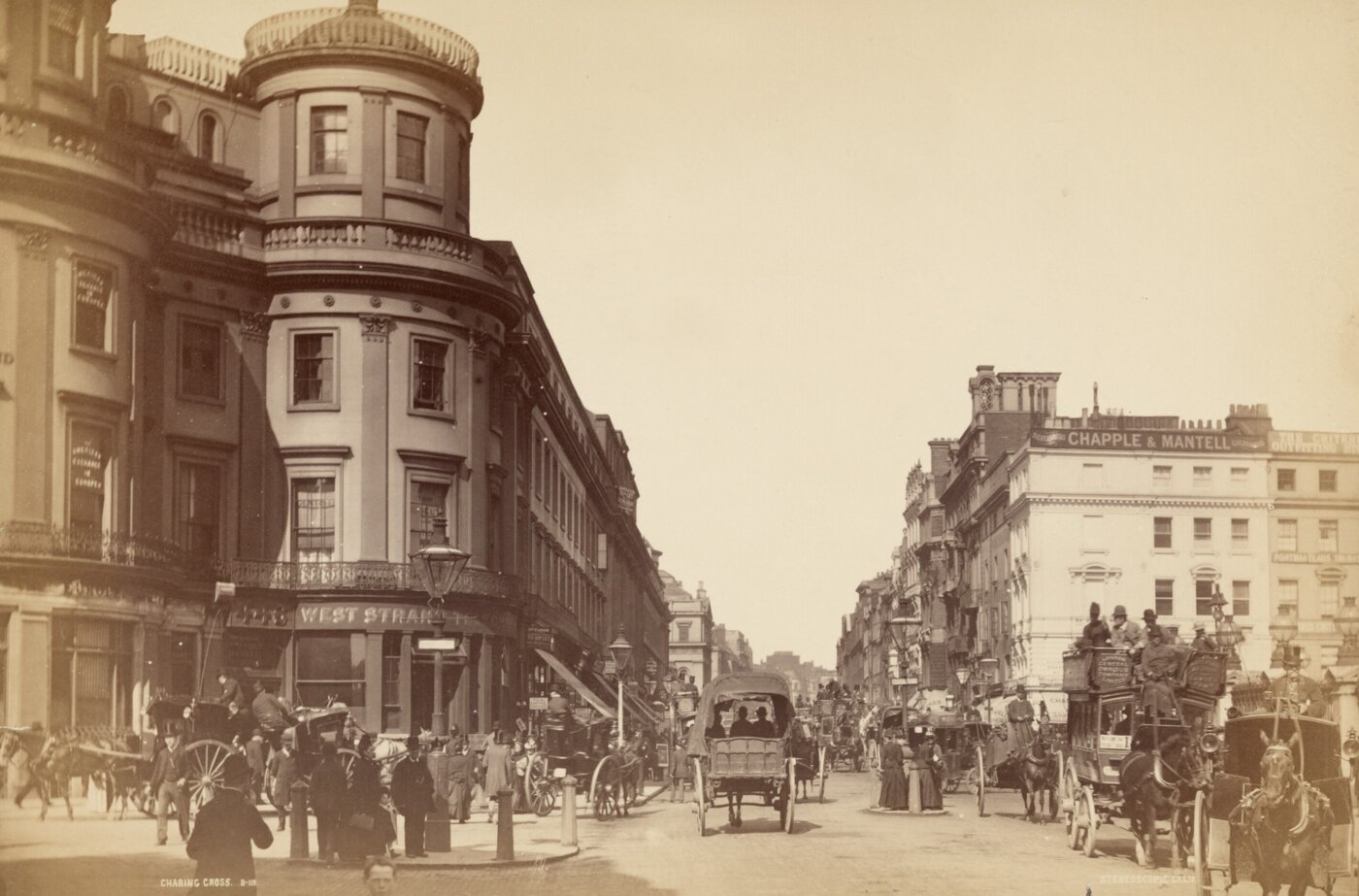
London Stereoscopic and Photographic Company, “Charing Cross” (Photograph, London, United Kingdom, [c.1860-1880]), The Getty Museum, Los Angeles, United States. Public domain. This photograph of busy Charing Cross in London was taken around the same time that William Ivens returned to his home city. On the right-hand side is a London omnibus, similar to the kind that William Ivens would have been familiar with in his first job as a messenger for the Railways & Metropolitan Omnibus company.
William Ivens arrived back in his birthplace and hometown of London in May 1881. By late summer, he had gained employment as a messenger for the Railways & Metropolitan Omnibus Company (Craft 1881a; 1881g; 1881h). Perhaps his experience working on the Railway Mail Service helped procure him the position, but without family in England, he turned to the network of benevolent patrons his parents had cultivated. This group included former white British abolitionists Elizabeth Pease Nichol, Frederick William Chesson, and Robert Nicholas Fowler.
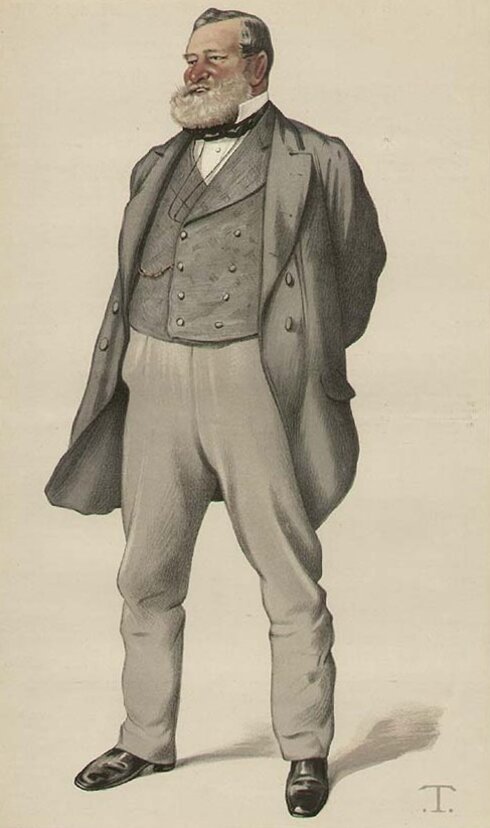
Théobald Chartran, “Robert Nicholas Fowler,” Vanity Fair, 25 June 1881, Wikimedia Commons. Public domain. Robert Nicholas Fowler was a former British abolitionist, member of parliament, and later Lord Mayor of London; he was a highly connected and wealthy man. Knowing that Fowler had aided his parents in their time of need, William Ivens wrote to Fowler upon his return home in London.

Seeking a safety net akin to the one that had supported his parents, William Ivens wrote to Chesson that he was “sure I could get a promotion as clerk if I could only get a decent suit of clothes,” asking for even a “‘cast off’ from any of your friends” (Craft 1881f). His position as messenger paid twelve shillings a week, and he boarded with a “Mr. Crosher” at 12 Blue Cross Street in Leicester Square.
William Ivens informed friends that this meager income did “not admit of my buying anything whatever for myself,” and it was “not enough with which to buy food” (Craft 1881h). Chesson loaned William Ivens small sums of money and also connected him to a Mr. Struge, through whom William Ivens was able to procure a much-needed overcoat for the winter (Craft 1882c; 1881a; 1881g).
William Ivens and the Former Abolitionists
Though William Ivens Craft received some material aid, the exchange that unfolded between him and Elizabeth Pease Nichol revealed the limits of abolitionist benevolence and the paternalism that pervaded reform in the Victorian era. Yet it also revealed William Ivens’ determination to persevere in London.
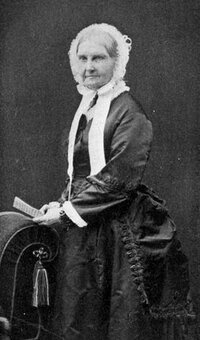
“Elizabeth Pease Nichol,” in The Life and Work of Susan B. Anthony, by Ida Husted Harper, vol. II (Indianapolis: The Bowen-Merrill Company, 1898), 568, Wikimedia Commons. Public domain. This image captured the likeness of Elizabeth Pease Nichol late in her life, offering a sense of what she might have looked like when she sat down to write her letters to and about William Ivens.

Elizabeth Pease Nichol demonstrated considerably less munificence towards William Ivens than she had towards those individuals of his parents’ generation who had experienced enslavement. In the mid-nineteenth century, she had been at the fore of British abolitionism, appearing as one of only about six women depicted in the famous Benjamin Robert Haydon painting of the 1840 Anti-Slavery Society Convention (Stoddart 1899, 123-124).
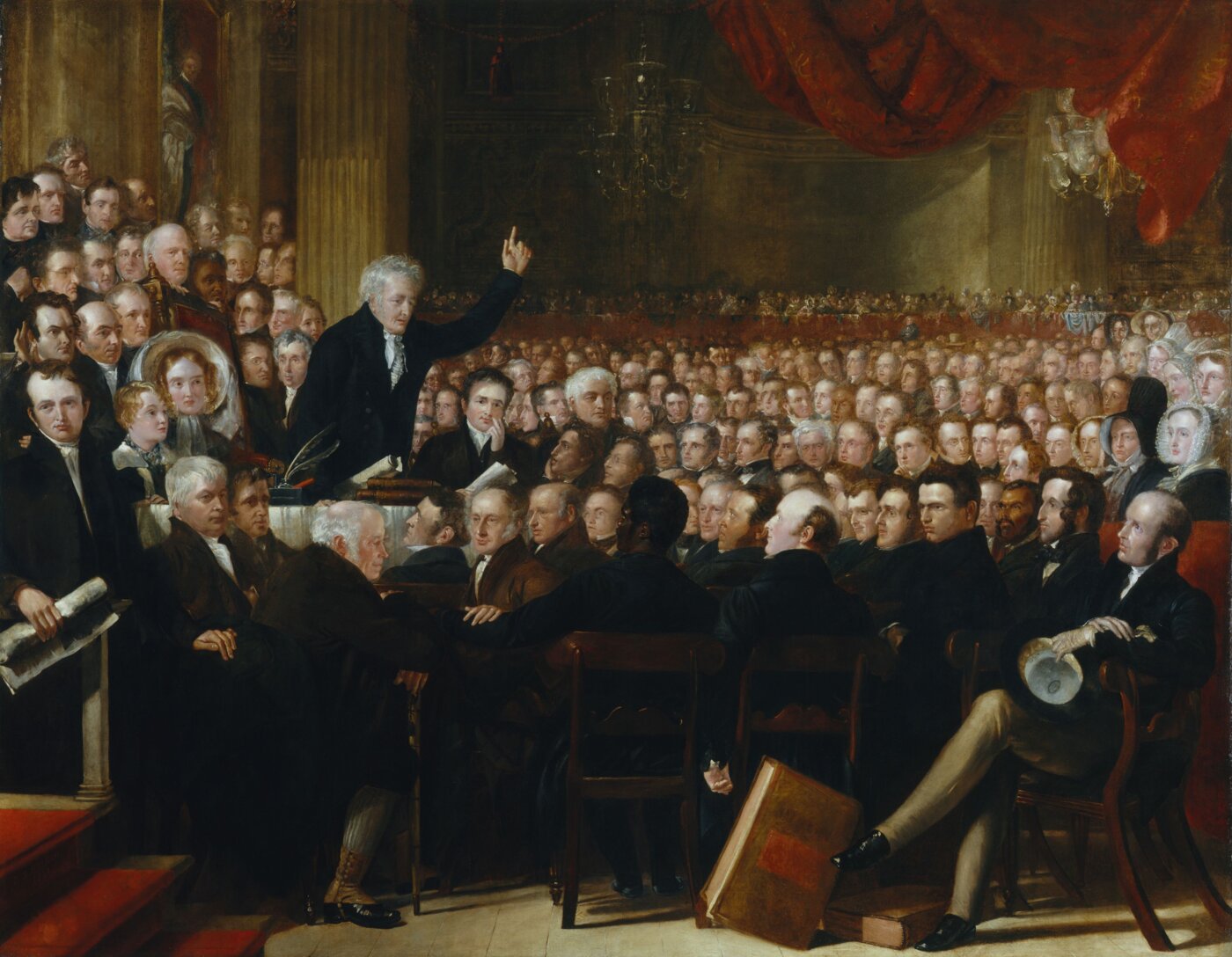
Benjamin Robert Haydon, “The Anti-Slavery Society Convention, 1840” (Illustration, London, [1841]), Wikimedia Commons. Creative Commons Attribution-Share Alike 2.0 Generic. Benjamin Robert Haydon’s painting of the 1840 Anti-Slavery Society Convention offers a snapshot of England’s most prominent abolitionists, including Elizabeth Pease Nichol (and Wendell Phillips). By the time William Ivens sought to utilize the same networks that had so eagerly supported his parents, these former abolitionists had turned their benevolent attentions elsewhere.

Before emancipation in the US, Nichol expressed her support of Black men and women in a letter to the New England Anti-Slavery Society:
We would encourage you to persevere with unremitting energy in the use of all Christian efforts, until the meridian splendour of that glorious day which shall witness the last link to be broken which binds the slave – until all the odious distinctions founded on colour shall be buried in oblivion, and the injured sons of Africa in your land restored to the full enjoyments of all the rights and privileges of humanity (Stoddart 1899, 52).
Though she had encouraged Black people to persevere until “all the odious distinctions founded on colour shall be buried,” when it came to aiding the children of formerly enslaved people, Nichol’s commitments to racial equality seemed to have run dry. By the 1880s, she had been secretary of a National Society of Women’s Suffrage chapter, championed the anti-vivisection cause, and had redirected her efforts towards “the erection of public abattoirs for a more humane method of killing animals for food.” The “chief incident” in her life during the year 1883, according to one biographer, “was the choice of a design for another fountain, finally erected in Holyrood Park” (Stoddart 1899, 284, 288-290, 292).
The Limits of White Benevolence
Thus, after two loans of two pounds each, Nichol insisted she had “done all I can for him” (Nichol, n.d.). William Ivens, pouring forth supplication and gratitude liberally in his letters, explained that although he had found employment, a short stint without work upon arrival in London had wound him “considerably into debt for board & lodging which I have not since been able to pay off insomuch that it has worried me greatly on my creditors persistently ‘dunning’ me for the money” (Craft 1881b).
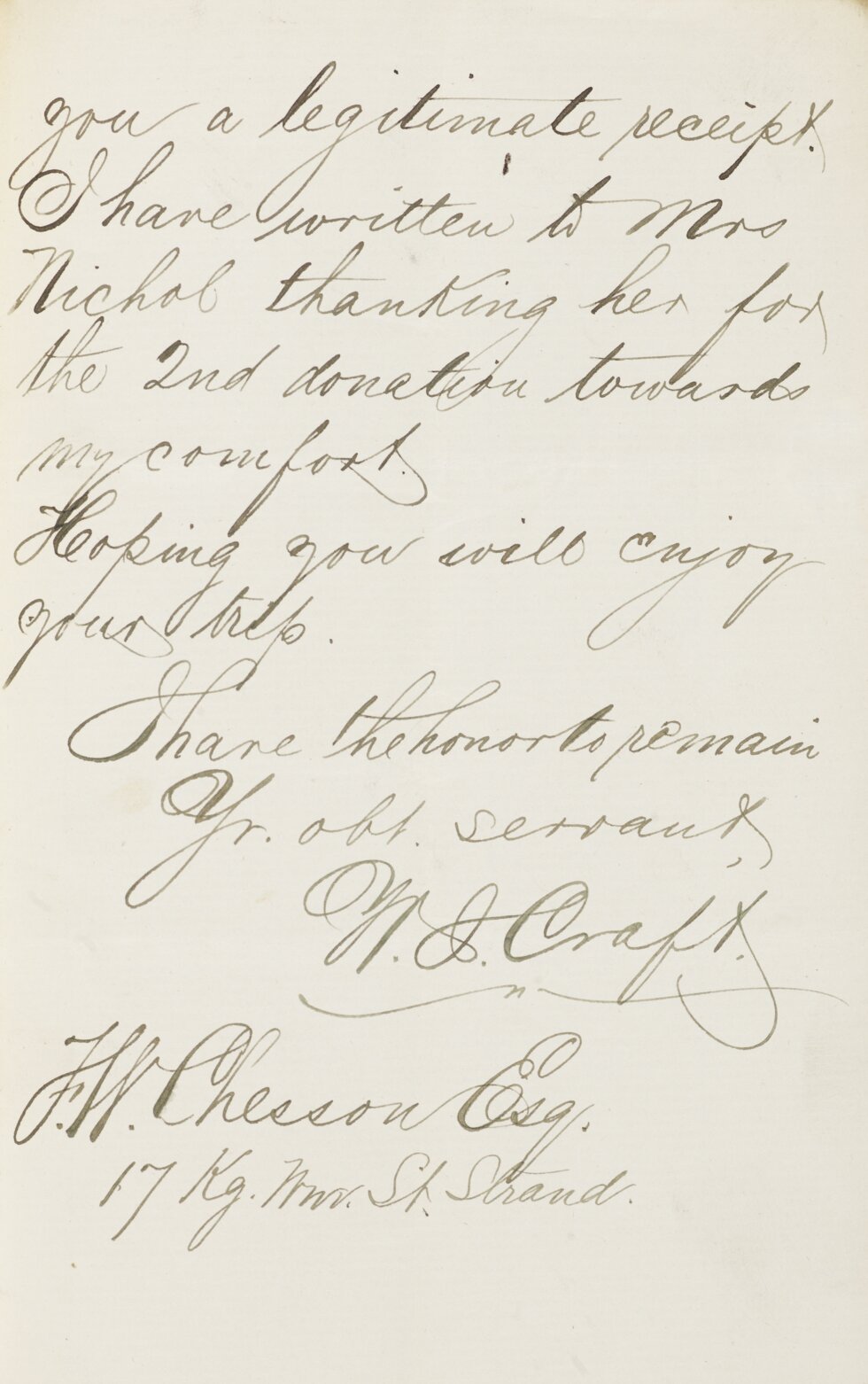
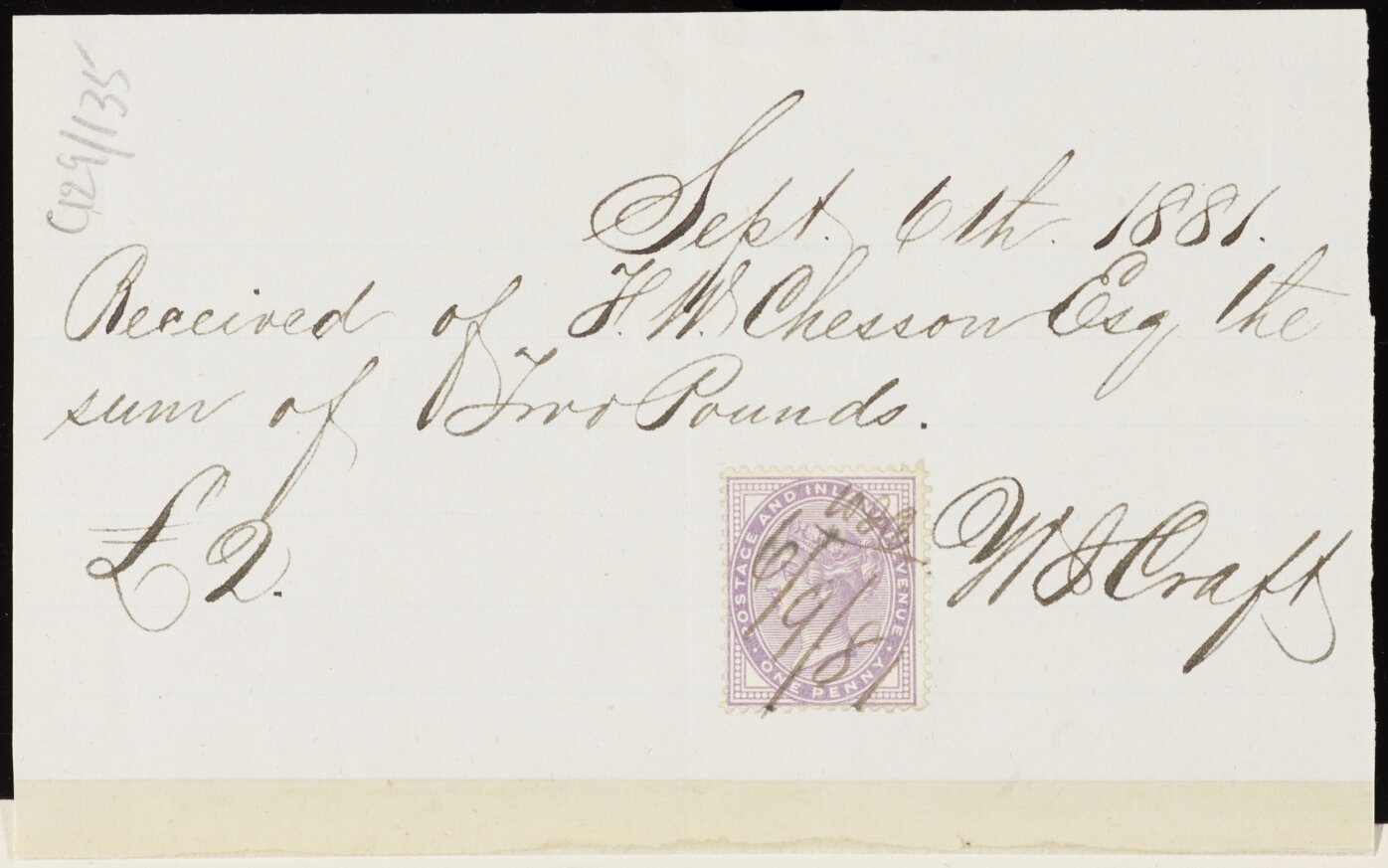
William Ivens Craft, “Letter to F. W. Chesson from William Ivens Craft” (Manuscript, London, 6 September 1881), MSS. Brit. Emp. S. 18, C129/134ii, Bodleian Library, Oxford, United Kingdom. Noncommercial use. This letter from William Ivens to Frederick William Chesson reveals much about not only the dynamics between the two men, but it also displays William Ivens’ advanced penmanship and grateful comportment, even while his requests for aid from here on out received no fulfillment.
Ellen Craft wrote to Nichol from Georgia, thanking her for her generosity and confirming the dire situation racism caused in the American South. “My son William,” Ellen stated, “writes to tell me of your extreme kindness towards him in England, and I am sure I am at a loss to know exactly how to thank you.” She assured Nichol that although William Ivens struggled in London, things were worse across the pond. In England, it was “so very much easier for a man of color to succeed in the race of life,” explained Ellen, “particularly if he has in any way had much to do with politics, the Southrons [sic] being still very much envenomed towards men of that class” (Craft 1882). Her comments hinted that William Ivens was also likely involved in Republican organizing while in Georgia.
William Ivens’ brother, too, encouraged him to “stay a while yet” in England due to “some circumstances” over which William Ivens “had no control” (Craft 1882b). Williams Ivens relayed this information to Nichol.
Yet white abolitionist attitudes had evolved in both the United States and Britain in the thirty years since Ellen Craft had first arrived there. Many of the Crafts’ white former allies on both sides of the Atlantic had either turned their shoulders or had moved on to other philanthropic causes (Foreman 1997, 336). There were notable exceptions. Lady Byron, for example, gave Ellen Craft several thousand dollars to help fund the co-operative school (McCaskill 2015, 83). As the libel trial made clear, however, many of the Crafts’ white abolitionist friends did not wholly support their post-emancipation endeavor.
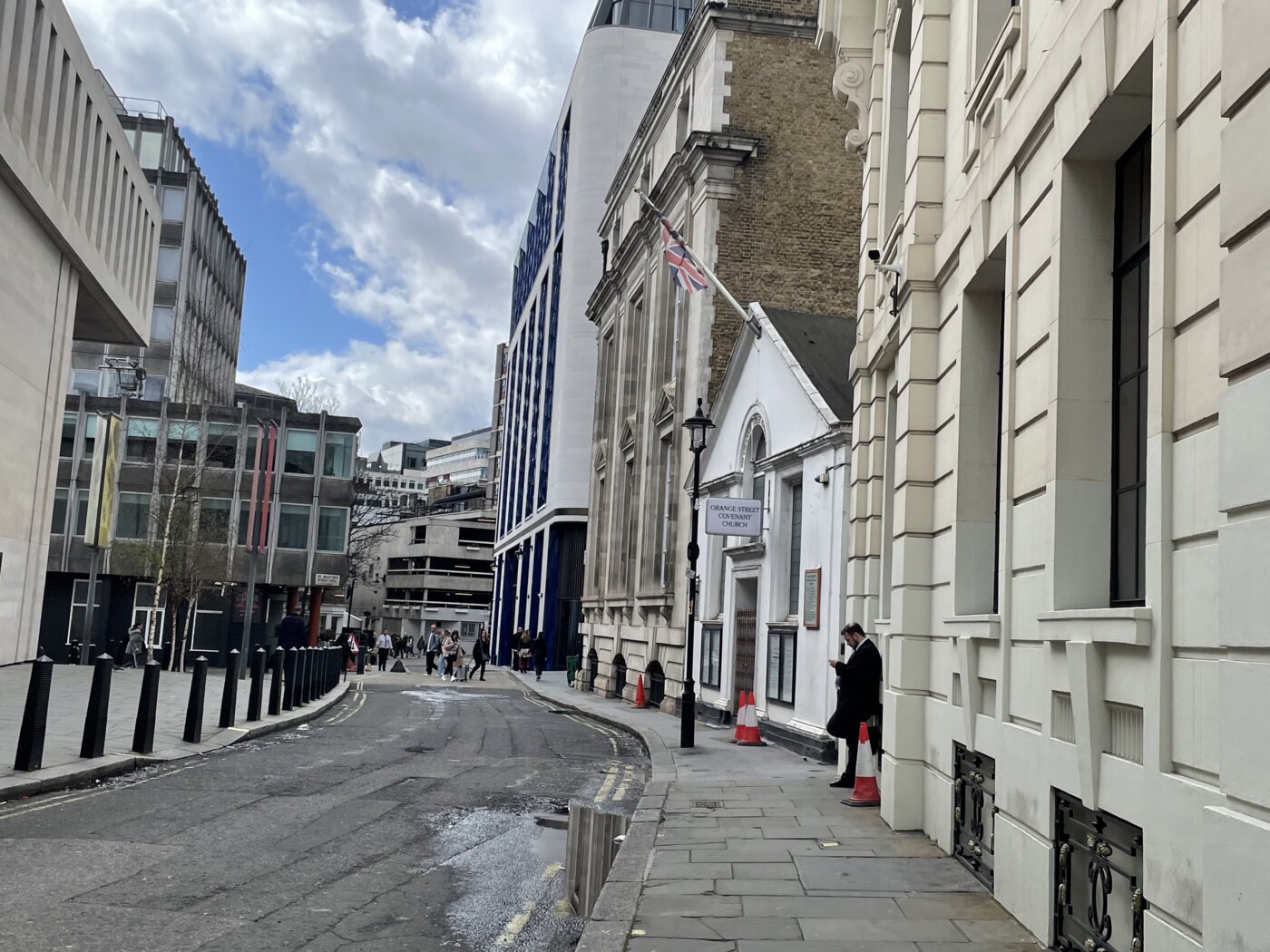
Hope McCaffrey, “Street View of Orange Street” (Photograph, London, 25 March 2023), Hope McCaffrey Private Collection. Creative Commons Attribution 4.0 International. The view, as of 2024, of the street where William Ivens boarded upon his return to London. Previously known as Blue Cross Street, today’s Orange Street is just south of famed Leicester Square.
Former British abolitionists, like Nichol, had turned their interests elsewhere. During the Civil War, white British abolitionists had started freedmen’s aid societies. White British attitudes towards freedmen, notes historian Christine Bolt, were “lofty, paternalistic and narrow,” while the “question of free labor,” importantly, “touched Britons on the raw.” British freedmen’s aid societies emphasized, above all, that freedpeople accept the system of waged, or “free,” work (Bolt 1971, 34, 46, 50, 54).
Nichol’s letters reflect such attitudes about the value of free labor. Nichol dismissed the obstacles that William Ivens faced, instead choosing to construe his difficulties as personal shortcomings. She wrote to Chesson that she was “a little afraid he,” meaning William Ivens, “does not like work.” “Between you & me,” she added, “Should it seem best to send him back to his father I wd [sic] help you in doing so” (Nichol, n.d.).
Nichol was not the first former white abolitionist to stereotype William Ivens as lazy. Wendell Phillips, a close friend of Nichol, had also smeared him as such several years prior – despite the long list of occupations the young man had already held (Stoddart 1899, 131). In contrast to Nichol’s formulation that William Ivens was averse to labor, his letters reveal a humble but feisty determination, despite the obstacles he faced, to carve out a sense of place and belonging in London.